
Dr. Robin Zeng: From Rapid Expansion to Long-Term Reliability, Energy Storage as Critical Infrastructure
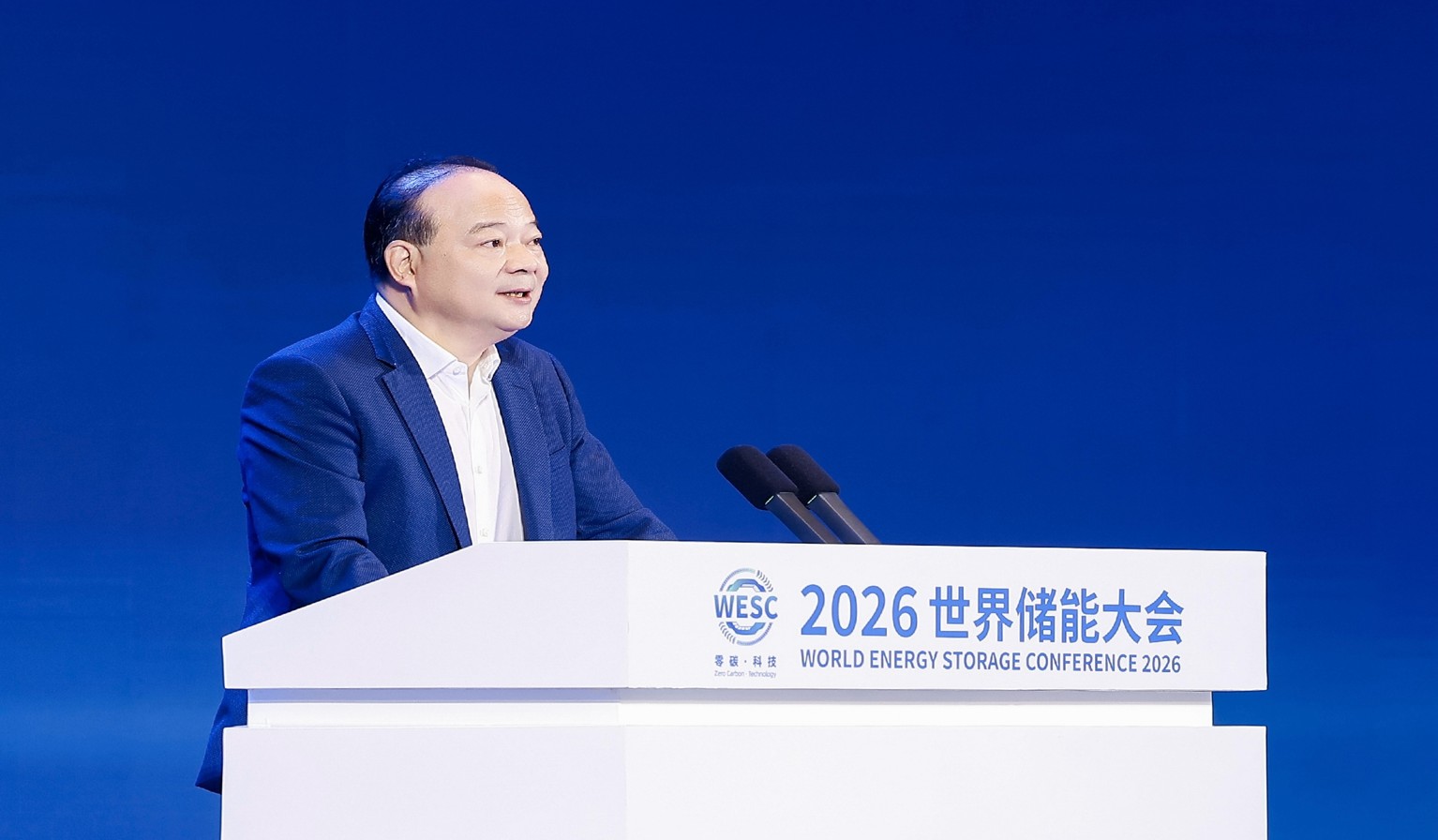
It is my great pleasure to join you at the 4th World Energy Storage Conference to discuss the future of the global energy storage industry.
The global energy storage market has grown rapidly this year. According to SNE Research, global shipments of energy storage batteries increased by 71% year-on-year in the first half, with markets outside China accounting for more than half of total shipments for the first time. From Europe and the United States to emerging regions such as Latin America, Southeast Asia, and Africa, an increasing number of countries are deploying energy storage at scale.
More important than the growth rate is the fundamental shift taking place in the role of energy storage within the power system.
Over the past decade, and more, the global energy transition has made significant progress, with continued expansion of clean energy installations such as wind and solar. However, challenges related to the stability of power generation have also emerged. At the same time, the electrification of industry and transportation is accelerating, while data centers and other power-intensive facilities are driving rapid growth in electricity demand. Together, these trends are placing higher demands on the reliability and flexibility of power systems.
Against this backdrop, energy storage is evolving from a supporting solution for new energy into an indispensable part of power system infrastructure.
This means that the energy storage industry must look beyond equipment-level performance metrics and focus on developing system-level capabilities that meet grid requirements and ensure long-term reliability.
To establish energy storage as a core part of power system infrastructure, I believe the energy storage industry needs to strengthen three key capabilities.
First, we need to develop end-to-end solutions tailored to diverse grid requirements.
As energy storage becomes an integral part of power system infrastructure, evaluation criteria must extend beyond equipment capacity, efficiency, and cost, to include a system's ability to provide grid support, respond to changing conditions and deliver effective power regulation.
Grid requirements vary significantly across regions. In Europe, it requires more flexible resources to integrate more renewable energy. In the United States, the rapid growth of AI data centers is increasing demand for highly reliable power. In Africa and Southeast Asia, where grid infrastructure is less developed in some areas, energy storage must also take on tasks such as voltage support and frequency regulation.
Addressing these differentiated needs requires a deep understanding of the power grid, the integration of battery cell technology, power electronics, and intelligent control technologies, as well as the overall optimization of energy storage power station operations.
CATL has deployed over 3,000 energy storage projects globally, tests more than 100,000 battery cells each year and has accumulated over 500 billion operational data points. These practical experiences and R&D data accumulations help us gain a deep understanding of grid operating conditions in different regions. We use these insights to incorporate real-world operating requirements into our system solutions, improving the grid compatibility and the operational reliability of our energy storage power stations.
Recently, we supported the commissioning of Supernode, Australia's largest energy storage project, through our integrated power station delivery approach. The project is expected to supply clean electricity to support the 2032 Brisbane Olympic and Paralympic Games. The Hydra project we delivered in South Africa has also entered operation. As Africa's largest hybrid renewable energy project, it is expected to meet the annual electricity needs of 200,000 households.
Second, we must drive fundamental innovation to meet the demands of complex operating scenarios.
Energy storage has been deployed across an increasingly wide range of applications, and has been operating in more demanding environments. In high-temperature environments, better thermal stability is needed to achieve lower auxiliary power consumption. In cold climates, good performance and equipment capacity must be maintained. In scenarios with rapidly changing loads, higher power output and faster response times are required. Ultimately, these challenges must be addressed through fundamental innovation in materials and electrochemistry.
CATL has long pursued the development of multiple battery technologies in parallel. For example, sodium-ion batteries offer strong low-temperature performance and resource availability advantages, complementing lithium-ion batteries. Through materials and system structure innovation, we ensure stable cell operation under high ambient temperatures. For the highly dynamic loads of AI data centers, our high-rate cells, combined with intelligent control strategies, achieve precise, millisecond-level system response.
Third, we must move beyond component-level testing to systematic, station-level validation.
A large-scale energy storage power station is a complex system. Even if every individual component meets standards, this does not guarantee long-term reliability at the system level.
Therefore, reliability verification must extend from individual cell and equipment testing to station-level, full-scenario validation. We need to simulate real-world, and even more stringent, environments to test the system's operational boundaries, thereby identifying and resolving issues before commissioning.
In May this year, we officially launched the Xiamen Energy Storage Validation Research Institute (ESVL), with a planned total investment of RMB 3 billion. The institute can conduct comprehensive testing at the power station level, covering grid integration, extreme environmental conditions and electromagnetic compatibility. It is now open to the entire industry. To date, ESVL has conducted systematic validation for 32 energy storage projects worldwide, covering a combined installed capacity of more than 16 GWh.
Ladies and gentlemen, the global energy storage industry is facing unprecedented development opportunities. But rapid growth is only the beginning. For energy storage to become infrastructure, it must stand the test of time.
CATL will continue to work openly with partners around the world to advance technological innovation, strengthen station-level validation, and support the high-quality development of the energy storage industry. Together, we can help make energy storage a reliable, long-term foundation for the global energy transition.
By clicking on the button “I accept” or by further usage of this website you express consent with usage of cookies as well as you grant us the permission to collect and process personal data about your activity on this website. Such information are used to determine personalised content and display of the relevant advertisement on social networks and other websites. More information about personal data processing can be found on this link. Read More